
As disabled people, we have a range of impairments and health conditions but we are disabled by the way capitalist society fails to recognise or meet our needs, seeing us as of lesser value, especially those of us who are unable to be sufficiently active in donating our labour to capitalist enterprise. This is what is known as the’ social model’.
As a result ,we are viewed as dangerous to the prosperity of the countries in which we live. We are often seen as a burden particularly in situations where resources are scarce. And the development of eugenics has seen us as a threat in the same way as birth defects or hereditary illness are thought to endanger livestock.
The idea that human imperfections should be ironed out by preventing disabled people from reproducing became popular in the last century. In Britain, despite campaigns supporting it, the enforced sterilisation of disabled women didn’t become law, but it did happen elsewhere, for example in the USA and Canada as well as Nazi Germany in the 1930s as a precursor to the T4 policies that sought to exterminate disabled people, including those with physical and sensory impairments, mental health conditions and learning impairments.
Despite the United Nations Convention on the Rights of Disabled People’s ruling against forced sterilisation, forced contraception or forced abortion, for disabled women many countries continue such practices. Only nine EU countries criminalise forced sterilisation as a distinct offence, whilst thirteen allow it to be performed on disabled people – and in three of those countries this includes minors.
Two years ago a conference of the European Economic and Social Committee on Disabled Women’s Sexual and Reproductive Health Rights discussed numerous examples of stereotyping of, lack of support for, and numerous abuses of disabled women, including, for example, deaf women, forced to have abortions in case they gave birth to deaf babies. There have also been cases of women sterilised not only without their consent but without them even being told it had happened.
There are also forms of coercion that stop a little short of forced sterilisation especially in contexts where doctors have strong opinions about what would be appropriate for disabled women. Although patients are supposed to be given sufficient information to be able to give informed consent, there are differences in the way this can be done and there are those who weigh in heavily with their personal opinion.
The following passage is an account of her experiences by the late Sandra Daniels, an excellent comrade and a valued friend to many of us. She was clear what she wanted and had the strength and determination to insist on getting it, despite the advice given. Many disabled women might not have felt as confident in dealing with a medical professional.
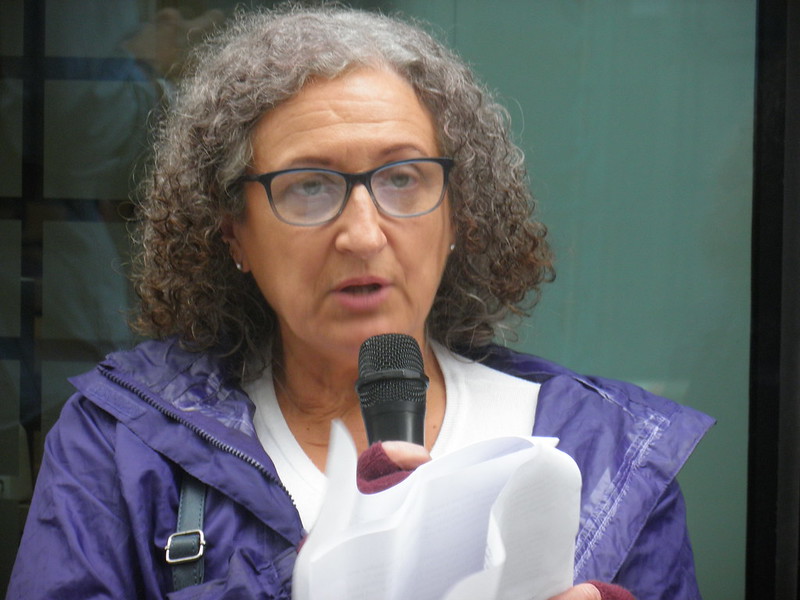
Despite her own experience of being pressured not to have children, Sandra was also a strong defender of bodily autonomy for all. In London for another event, she joined other women in opposing the grotesquely misnamed ‘March for Life’ shouting slogans such as ‘Not the church, not the state, women must decide their fate’ with every ounce of her formidable energy
Sandra wrote:
“I was born in 1963 having a congenital impairment called Spina Bifida. My mother had no knowledge of my impairment before I was born and was shocked and distressed at giving birth to a disabled baby. She was given the worst-case scenario by the medical profession and was told my life expectancy was unknown. My mother spent the first few years of my life expecting me to die.
“As the years passed it became clear that the medical predictions and assumptions were not necessarily accurate, and this helped to increase her confidence as the mother of a disabled child and she was able to progress and think of ways that I could be independent and live the life I wanted.
“When I reached adolescence, my mother wondered if having children of my own would be possible, so arranged for me to see a medical specialist on my reproductive situation. The specialist advice was for me not to have children, as this could potentially result in increasing my impairment and miscarriage.
“When I became pregnant with my first child it was a tense time for all concerned and I was advised by a doctor to have an abortion, but I wanted to have my baby and nothing was going to stop me. My first child was a girl and several years later I went on to have a boy. My children are now grown up and I am the grandmother to five grandchildren.
“When I was in my twenties, my mother told me that the day I was born at one time seemed one of the worst days of her life, but she had grown to realise it had been one of the best because she had a daughter in her life”
She ends with a quotation from Ani DiFranco:
“My idea of feminism is self-determination, and it’s very open-ended: every woman has the right to become herself, and do whatever she needs to do.”
NB: Featured image: Outline figure holding green triangular scarf above their headhead level with the words ‘our bodies, our lives, our right to decide’.