

‘Keep politics out of sport’ is still heard. By a strange coincidence the strongest advocates of that saying also tend to hold the most right-wing views. For example, those seeking apolitical sport would like to see an immediate resumption of all sporting links with the white racists in South Africa. Sport has always been a class issue. Trevelyan claimed that: ‘If the French noblesse had been capable of playing cricket with their peasants, their chateaux would never have been burnt’. Undoubtedly, he overestimates the influence of cricket but there is a grain of truth to be found in that statement.
From popular recreation to organised sport
Sport as we know it in Britain today has its origins in the fifty years prior to the turn of the century. Between 1850 and 1900 all the major sporting institutions were established. To take a few examples: 1860, the open golf championship; 1863, the Football Association; 1866, the Amateur Athletic Club which later became the Amateur Athletic Association; by 1870 nearly all the county cricket teams had been formed; 1871, the Rugby Football Union. A sporting revolution had been affected which transformed the leisure activities of the working masses. The organisation of popular, sporting, recreations stemmed from a concern for discipline and was a direct consequence of the needs of urban, industrial society.
During the 18th century popular recreations were characterised by being disorganised, rural, often violent, with widespread participation and occasionally used as a pretext for political action. In 1720 the main pastimes included football, wrestling, cudgels, ninepins, cricket, bell ringing, quoits, badger, bear and bull baiting,. cock fighting, drinking in the 50,000 or so alehouses and eating scalding porridge with bare hands! The Shrovetide football match in Derby is an interesting example. The goals were a mile apart. Between 500 and 1000 participated on each side and the river was an accepted part of the playing area. Clearly such mass gatherings could get out of hand and lead to riots. Sometimes the reverse was true in that the games were used as a pretext for a gathering. In Popular Recreations in English Society there is a case cited of ‘a match of Futtball was cried at Ketring of five Hundred men a side but the Desighn was to pull Down Lady Betey Jesmains Mills’.
In the mid 18th century, despite pressure from puritan reformers, these rural recreations persisted and thrived. Less than a century later industrialisation had changed the geographical, social and political face of Britain. No provision for sporting or recreational facilities had been made in the new industrial towns. Sport was prohibited on the public thoroughfares, but most importantly it was the machine which determined the rhythm of life not the agricultural seasons. Leisure time was severely restricted. During the second quarter of the 19th century the real low point was reached as the traditional forms of culture had disappeared with nothing to replace them.
In the following twenty-five years some important changes occurred in the social life of Britain as it affected the broad masses. In 1847 the Factory Act shortened the working day to 10 hours and led to the introduction of the five-day week with the major advance of free Saturday afternoons. The 1870 Education Act not only widened literacy but also saw the beginnings of the introduction of sport into state schools, while the 1871 Bank Holiday Act brought millions their first public holidays. The significance of these measures was that the working class in the towns had some, albeit restricted, time for leisure activities. The ruling class and its institutions were quick to recognise the necessity of providing some framework for that time which they did not already directly control from within the factory gates.
In 1883 the Football Association Cup Final was won by the Old Etonians. That was the last time that a southern, amateur, side ever won the Cup. Football had been pioneered in, and by, the public schools but this situation was completely transformed by the turn of the century when the game had won widespread male, working class participation and support. The spread of football had received an impetus from three sources. First, the Church recognised the importance of physical recreation: ‘The laws of physical well-being are the laws of God’. In Birmingham in 1883 one quarter of the 344 football clubs were church teams and many of the contemporary league sides, such as Aston Villa, Everton and Fulham can trace their origins there. Secondly, the public houses saw that a team was good for business. The landlord was prepared to incur the expenses for equipment and facilities that were still beyond many working class communities. Thirdly, local firms quickly realised that sport could assist in generating social and industrial harmony.
The case of Thames Ironworks provides an interesting example. The owner Arnold Hills was ex-Harrow and Oxford and former English mile champion, as well as being a strong advocate of temperance, vegetarianism and good causes. After a strike at the workshop he launched a football club as a means of restoring good will. The team ultimately became West Ham United, though Hills opposed the professionalisation of football being a strong advocate of amateurism. He feared that the team had become ‘gladiators’. Arsenal had similar origins in a munitions factory and Coventry City at the Singers Cycle Factory. Such a phenomenon was not restricted to Britain. In North America, Carnegie founded baseball and American football teams around the Bessemer steel plants and by 1940 twenty million workers were playing sport for factory teams.
Sport and the labour movement
In the 1890s certain socialist groups in Britain had recognised the importance of recreation for the working population. In 1895 the Clarion Cycling Clubs were formed. The Clarion was a one penny, large format, 8-page weekly paper, edited by Robert Blatchford. Cycling had taken on such importance for the Clarion that by 1897 an entire page was given over in the paper to articles about bicycles, club news and advertisements for tyres, saddles and handlebars. Cycling outings were not just recreation. They were also the form of transport to public meetings in the crusade for socialism that the Clarion pioneered.
During the 1920s and 1930s the workers sports movements had very broad followings in central Europe. It was in Germany that these organisations maintained the greatest support. In 1929 the ATUS -a body which coordinated the labour sports and gymnastic groups- had a membership of 1.2 million, while the German Communist Party also had its own sporting organisation of 250,000. The ATUS published 60 sports papers with a combined circulation of over 800,000. Similar organisations existed in Austria and Czechoslovakia. In 1931 the Socialist Workers Sports International, which claimed a membership of more than two million, organised an Olympiad in Vienna – a city then under the political control of social democracy. On the final days there was a demonstration by 100,000 sportspeople from 26 countries, watched by a crowd of a quarter of a million. These Olympiads were clearly counterposed to the Olympic Games which had begun in 1896.
The Comintern had its own Red Sports International which had been established at the third congress of the Comintern. In 1928 they organised an international sporting Spartakiada in Moscow and a further one in Berlin in 1931. In Britain the Communist Party was closely involved in the British Workers Sports Federation which in 1932 organised the mass trespass on Kinder Scout, in the Derbyshire Peak District across land used by the Duke of Devonshire for shooting parties. Such actions played an important role in opening up the countryside but still today large parts of the land, even uncultivated areas, remain closed to the public. It would appear that the movement went so far as to organise a workers Wimbledon tennis tournament in Reading during the thirties! The importance of such workers sports organisations can be seen by the fact that one of the first measures undertaken by Hitler upon taking power in Germany was to suppress the ATUS. The following year, 1934, similar action was taken against the Austrian ASKО.
Sport and industry
Industry pervades every aspect of life and sport is no exception. This takes various forms but the following three are the most striking.
- Sponsorship. Every year in Britain more than £20 million is put into sporting competitions by industrial sponsors. Many occasions would not occur without that finance for which firms receive substantial, free advertising. Virtually every sport has its sponsors. To take the example of cricket there is the Schweppes County Championship, the National Westminster Bank Trophy (formerly the Gillette Cup), the Benson and Hedges Cup, the John Player League, until last year there was the Lambert and Butler floodlight trophy, the Cornhill test matches and the Prudential one day test series. Additionally, many of the county teams have local sponsorship. Surrey has two deals worth several thousands pounds from car and medical insurance companies. It should be stressed that cricket is the norm not the exception, and that sport and industrial sponsorship move hand in hand.
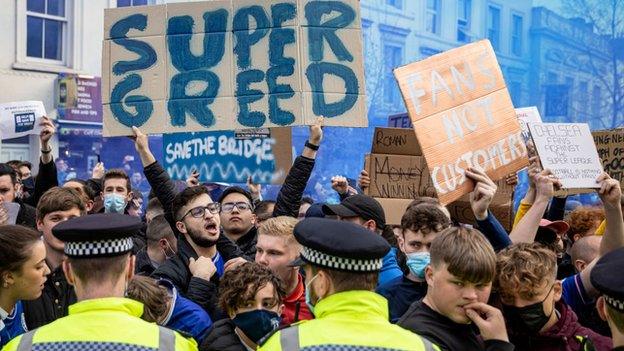
Since the restrictions imposed on cigarette advertising on television, sponsorship of major sporting events has been one way of keeping the brand name in the public eye, which is ironic given the harmful nature of smoking. Likewise Coca Cola, which despite the fact that the secret formula is known to contain the highest concentration of sugar and caffeine of any soft drink and hence to be the most harmful, has availed itself of the title official soft drink for the World Cup 82 in Spain, and had established a similar position for the Moscow Olympics two years ago prior to the American boycott. Sport sponsorships are the marketing department’s dream.
- Sports commodities. The most obvious commodities are often the players themselves as can be seen in the transfer system of players from one club to another. Until recently in professional sports the players had been treated very poorly. It was only in 1958 that footballers won the right to a maximum wage of £20 and after a further prolonged campaign the maximum wage concept was abolished. Since that time the salaries of the top soccer stars have increased dramatically. Among cricketers it was not until 1978 that a minimum wage was established.
Prior to that many of the worst aspects of the class system pervaded the game. Until the 1950s it was always an amateur player who captained the side. Len Hutton was the first professional to be appointed England captain and that was in 1952. Within the West Indies the choice had to be not only an amateur but also a white player. In 1961-62 Frank Worrell became the first black cricketer to be chosen, captain of the West Indies after a very vigorous campaign in which CL R James. then editor of The Nation, played a major part. The amateur players used different changing rooms, entered the field by a separate gate, stayed in better hotels and were addressed as “sir’. Those anachronistic hangovers may have been removed, but cricket is still run and controlled by men whose approach to the game is formed by that ethos.
Sport also generates an industry of its own in equipment and accessories most of which carry the endorsement of a well-known star. Governments are well aware of this lucrative market. The winter Olympics held in Grenoble in 1968 cost the French state £135 million but not only did it give French tourism a much needed boost it also gave French manufacturers a bigger slice of the European ski market.
*Gambling. Betting and sport have never been far apart. In 1751 the Old Etonians took on an England cricket team for a prize of £1500 but it is estimated that £20,000 was at stake in side bets. Virtually all these early cricket matches were played for large sums of money, and to ensure success the aristocratic patrons, like the Duke of Richmond, employed the best plebian players on their country estates as gardeners or coachmen but, de facto, as cricket professionals. Today millions of pounds pass into the hands of bookmakers and the pools promoters from betting on horse racing, greyhounds and football matches.
Sport and ideology
Sport in bourgeois society helps transmit certain ideas that assist in the maintenance of capitalist rule.
- Respect for authority. Early sports administrators, who were predominantly Victorian and middle class, quickly recognised the need to provide a framework of laws and institutions. Consequently it was an amateur, public school ethic which prevailed. The notions of being ‘a good loser’, of ‘fair play’, of ‘not cricket’ and ‘playing the game’ are ingrained into young people playing games, as is of course the respect for the authority of the referee or umpire whose decision is always final and not to be questioned.
- Individualism and social advancement. Sport offers one of the few ways for a working class person to traverse the class boundaries and become a ‘success’ in bourgeois society. They can be readily accepted in the best social company and through a high sporting salary with advertising and endorsements, earn a good living. Very few make it, but the idea that ‘everybody can get to the top if they work, train or practise hard’ is important for the upper class.
- Nationalism. National unity can be forged around a sporting success which transcends all the social, economic and political problems that may exist at any given moment. The Argentinian World Cup Victory in 1978 is a good example. Sport has military overtones in terms of regimentation, discipline and physical fitness. It comes as no surprise to learn that the German and Italian fascists undertook the strict organisation of leisure time. In Italy it was done via a central state structure called the Dopolavoro (afterwork) which even went so far as to control dance halls. A leading Italian fascist Maraviglia said: ‘Fascism avails itself of the various forms of sports, especially those requiring large groups of participants as a means of military preparation and spiritual development, that is a school for the training of Italian youth.”
- In Britain sporting occasions have been used as an important mechanism for recruitment to the armed forces. In the first year of the 1914-18 war 500,000 of the 1,186,000 recruits were made at football matches. Recruiting offices were set up at every ground and speeches made before every match. Stadiums were transformed into prison camps as was the Santiago stadium in Chile in 1973 while the Lake Placid winter Olympic village is now a prison.
- Sexual discrimination. Within sport women have been systematically discriminated against. Their position within the home meant that as organised sport developed at the turn of the century women were unable to participate. Responsibilities for the family severely restricted their time outside the factories. Men, who have always run sport, regarded women as an intrusion into a male preserve. It was not until 1928 that women were allowed to participate in athletic events at the Olympic Games. At cricket grounds, until recently, women were not admitted to the pavilions but were given separate seating enclosures elsewhere.
Discrimination through the law has also blocked young women from participating in sports. In 1978, 12 year old Theresa Bennett won a court case against the Football Association who had banned her from playing for the Muskham United Under-12s team. But the Court of Appeal supported the FA and refused her right to appeal to the House of Lords. However the problem is deeper than that. I stems from sexual stereotyping at an earlier age and an education system which refuses to allow young women to play some sports. *Violence. Aggression, usually male, typifies many sports. The most obvious is boxing. Not only does it legitimise violence within society but the sport itself is physically damaging to the participants. It is estimated that 400 boxers have died in the last 25 years from injuries sustained in the ring, while there is growing medical concern over neck and spinal injuries caused on the rugby field, Within certain field sports, which in Britain have tended to be the preserve of the upper classes, the violence is against animals and birds. The shooting of pheasants and grouse, often reared simply for that purpose, as well as fox and deer hunting. are events ridden with class and social status. *Competitiveness. One feature of contemporary sport which distinguishes it from recreational activities is the aspect of competition. At the national level, with professional sport being played for high, financial rewards, winning has become paramount and entertainment often secondary. The media in fluence, in turn, has transmitted that spirit into local, amateur sport.
Striving for success has led to the use of drugs within athletics. Anabolic steroids which unnaturally develop muscles have become more common. Records have also taken on a greater significance as performances lose human content and become lists of facts and figures- an anonymous target for the next person to try and break.
Is there a future?
Recreational activity can be important for the individual. I do not wish to reject all game playing. Sport can be pleasurable to watch and to participate in. It can be an important form of self expression, particularly when counterposed to the boredom and routine of factory life. It can be an art form. The state needs to provide equality of access and facilities which does not happen at the moment. Playing fields and recreational facilities are under threat as the social services are cut. As long as the land remains in private hands there will not be freedom to roam.
It is the growing involvement of big business in sport that needs to be opposed. Recreation should not be seen as an extension for the marketing of commodities. But the question needs to be asked- why do we need professional sport at all? Cannot the specialised professional be dispensed with and returned to the community? Whatever the answer socialists cannot ignore a phenomenon which captivates millions of working people.